
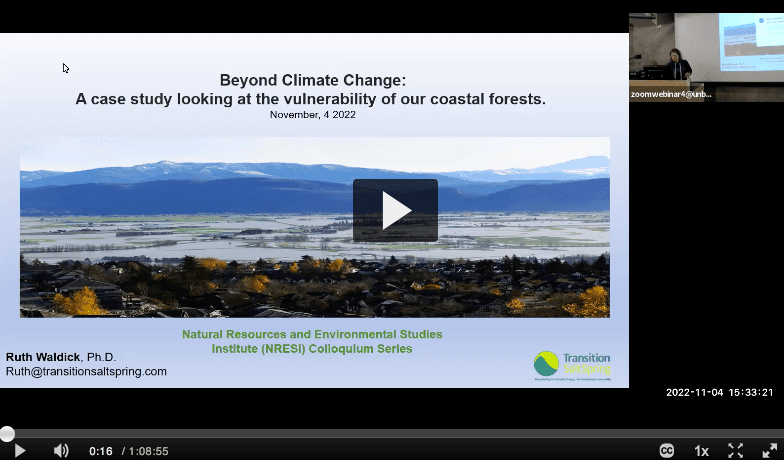
How do we protect the forests we depend on as climate impacts intensify? In this in-depth presentation, Dr. Ruth Waldick shares insights from the Mt. Maxwell Adaptation Lab on Salt Spring Island—an innovative project exploring how local ecosystems respond to fire, drought, and forest degradation.
Learn how place-based science, climate adaptation strategies, and community collaboration are guiding stewardship of one of Salt Spring’s most vulnerable yet critical forest systems.
Presenter: Dr. Ruth Waldick
Recorded: November 11, 2022 at UNBC
Duration: 1 hour 8 mins
Watch the Video
What You’ll Learn
- What makes Salt Spring’s forests vulnerable to climate change
- How ecological monitoring informs restoration
- Why the Maxwell Creek watershed is so important
- Ways to balance forest carbon, biodiversity, and fire risk
- How local research supports broader climate resilience
About the Presenter
Dr. Ruth Waldick is an ecologist and climate change specialist with deep experience in landscape-scale adaptation, science communication, and community-based research. She leads Transition Salt Spring’s Mt. Maxwell Adaptation Lab, a science-driven effort to restore and protect one of the island’s most critical watersheds.
Related Resources
- Learn more about Transition Salt Spring’s Climate Adaptation Research Lab